



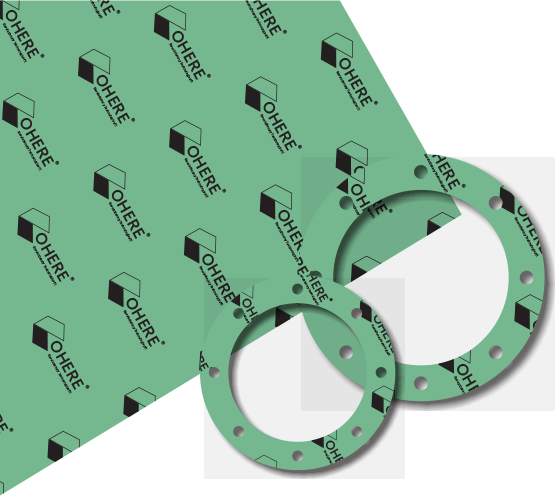
What is a Gasket? Complete Guide, Types, Materials, and Industrial Applications
A gasket is a mechanical sealing component placed between two mating surfaces to prevent leakage of fluids or gases under compression. Gaskets compensate for surface irregularities, vibration, and thermal expansion. They are used across process industries including chemical, petrochemical, oil & gas, power plants, pharmaceutical, marine, and HVAC.
How Does a Gasket Work?
- Soft gasket material deforms under bolt load.
- Fills micro-gaps on flange surfaces.
- Creates a reliable seal against pressure, temperature, and media.
Performance depends on:
- Material selection
- Operating temperature
- Pressure rating
- Chemical compatibility
- Surface finish
- Bolt load
Common Gasket Materials
- Non-Asbestos Fiber (CNAF)
- PTFE (Polytetrafluoroethylene)
- Graphite (Flexible and Reinforced)
- Rubber (NBR, EPDM, Neoprene, Viton)
Types of Gasket (Industry Standard Classification)
1. Soft Gasket
Suitable for low-to-moderate pressures.
Materials:
- Non-Asbestos Fiber
- PTFE
- Rubber
- Compressed Fiber
Applications: - Chemical pipelines
- Water lines
- General process sealing
Key Standard: ASME B16.21
2. Spiral Wound Gaskets
Construction:
- V-shaped metal strip + filler (graphite/PTFE)
Advantages: - Handles thermal cycling
- High pressure and temperature
Applications: - Refinery heat exchangers
- Chemical reactors
- High-pressure steam lines
Standards: ASME B16.20, API 601
3. Ring Joint Gaskets (RTJ)
Metallic sealing rings for high-pressure systems.
Profiles: R, RX, BX
Applications:
- Oil & gas drilling
- Refineries
- High-temperature valves
Standard: API 6A
4. Kammprofile (Camprofile) Gaskets
Grooved metallic core + soft sealing layer.
Advantages:
- Resilient under bolt load variation
Applications: - Flanges with limited sealing width
- Heat exchangers
5. Metal Jacketed Gaskets
Soft filler encased in metal.
Used in:
- Heat exchangers
- High temperature pipelines
Filler options: - Graphite
- Ceramic fiber
Specialty Gaskets
PTFE Envelope Gaskets
Chemical-resistant for corrosive media.
Ideal for:
- Chlorine
- Strong acids
- Alkalis
Rubber Gaskets
Variants:
- NBR: Oils and hydrocarbons
- EPDM: Steam, water
- Neoprene: Mild chemicals
- Viton: High-temperature chemicals
Graphite Gaskets
Advantages:
- Thermal cycling tolerance
- Fire-safe
- Chemical resistance
Used in: - Power plants
- Furnaces
- High-temperature valves
Gasket Selection Checklist
Evaluate:
- Temperature range
- Media compatibility (acid, alkali, solvent)
- Pressure class
- Flange facing (RF, RTJ, FF)
- Bolt load availability
- Regulatory requirements (Fire-Safe, FDA)
Failure Modes
Common causes:
- Insufficient torque
- Chemical incompatibility
- Flange misalignment
- Thermal cycling
- Creep relaxation
Mitigation:
- Proper installation
- Verified material selection
- Surface preparation
Industry Standards & Compliance
Recognized regulatory bodies:
- ASME (American Society of Mechanical Engineers)
- API (American Petroleum Institute)
- ASTM (Material standards)
- DIN / EN (European norms)
- BS (British standards)
- TA-Luft (Fugitive emission compliance)
Applications Across Industries
Gaskets are critical in:
- Chemical processing
- Oil & gas refineries
- Power generation
- Marine pumps
- Food & beverage pipelines
- Boilers and heat exchangers
- Pharmaceutical manufacturing
Why Correct Gasket Choice Matters
Correct selection improves:
- Leakage prevention
- Equipment reliability
- Worker safety
- Environmental compliance
- Operating cost efficiency
Emerging Trends
- Non-asbestos formulations
- Low fugitive emission gaskets
- Digital torque verification
- Fire-safe approvals (API 607)
Conclusion
Gaskets are essential sealing elements that ensure operational safety and efficiency across industrial pipelines and equipment. Selecting the right gasket material, thickness, and design is critical for reliable performance under varying temperature, pressure, and chemical conditions.
For industrial gasket requirements—including Spiral Wound Gaskets, CNAF sheets, Graphite gaskets, and PTFE solutions—reach out to Cohere Tech India Pvt. Ltd.
